
Employee advocacy
Employee Advocacy: A Practical Guide for B2B Teams
How to build a voluntary, credible advocacy approach where subject matter experts share what they know in their own words, not the company's.
What if the best way to build employee advocacy is to stop asking employees to sound like the company? In B2B, a polished, approved post can still feel generic when it doesn't reflect the person sharing it. Even knowledgeable employees may hesitate when they're unsure what to say or how much of their own perspective to include.
That hesitation makes sense. People have expertise worth sharing, but they don't need another script or a vague request to "post more." Effective employee advocacy gives them room to speak in their own voice, with enough structure to make participation easier and keep company information accurate.
This guide explains what employee advocacy means for B2B teams and how to build a voluntary, credible approach. You'll learn how to help subject matter experts shape manageable LinkedIn posts from their real work, support participation without pressure, and understand what's working beyond post counts. The aim is practical: make it easier for employees to share useful ideas as themselves, not as a company account.
Key takeaways
- Build employee advocacy around voluntary contributions, not expectations that every employee should post.
- Choose topics that connect contributors' roles and expertise with what their professional audience needs to know.
- Use shared guidance to keep information accurate while letting each employee shape the wording and perspective.
- Start with a manageable workflow: set a focus, invite willing contributors, shape posts together, then review what the team learns.
- Use a collaborative workspace like LinkedTeams to help B2B teams develop organic LinkedIn content from their knowledge and experience.
What employee advocacy means for a B2B team
Employee advocacy is employees choosing to share relevant professional perspectives, experiences, or company information through their own networks. The choice matters. It isn't a requirement to promote every announcement or a request to turn personal profiles into company channels. In a B2B team, advocacy gives people room to contribute what they know and helps others see the work and thinking behind the organization.
The term is sometimes used alongside "social employee" or "employee advocate." A social employee is an employee who uses social media in ways that may contribute to an organization's presence. For B2B teams, the useful distinction is that contributions can start with an employee's expertise, not just with a company message that needs more distribution. When that expertise leads, advocacy overlaps with what we call employee thought leadership.
What counts as employee advocacy in B2B?
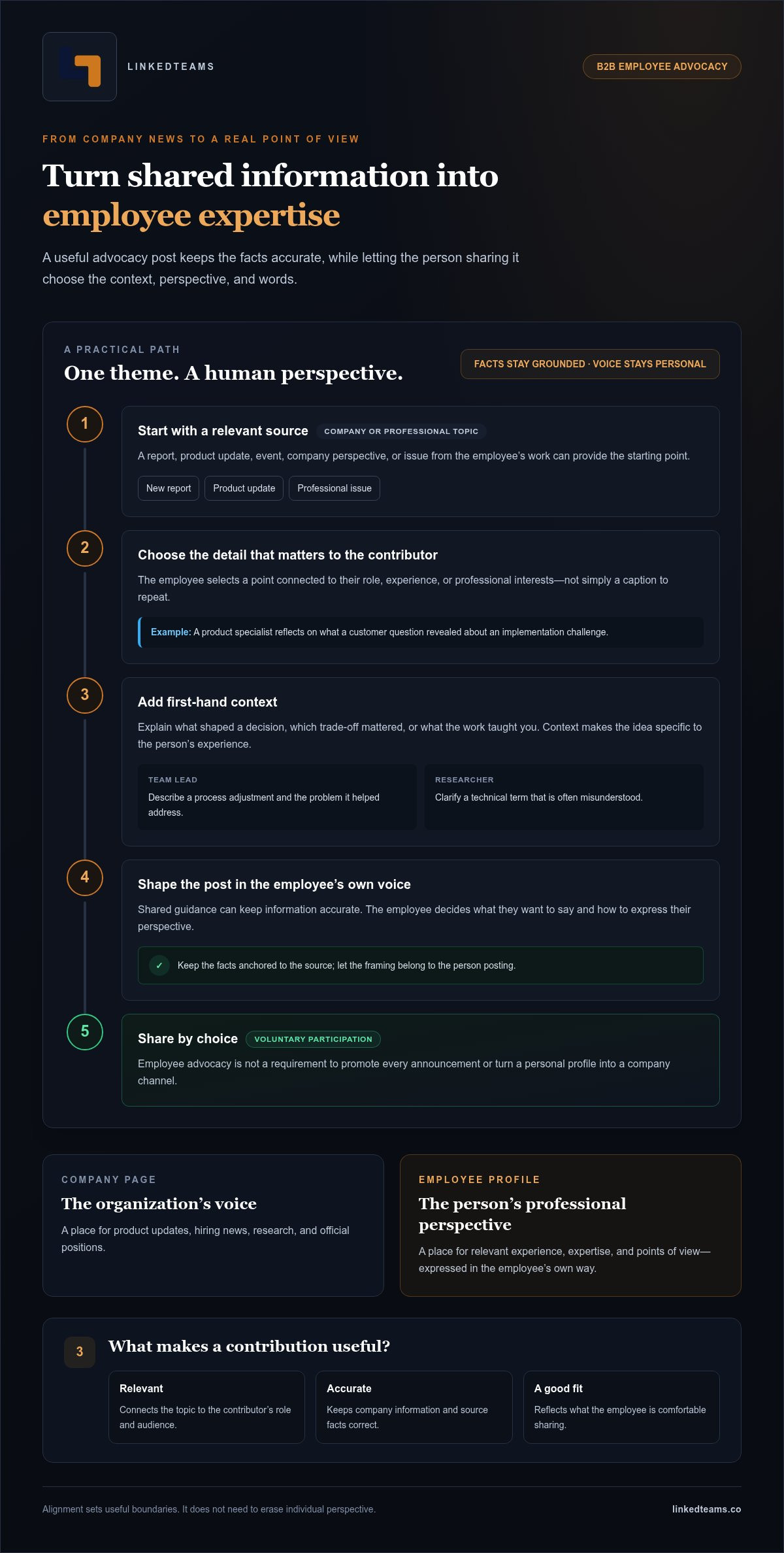
It can be a practical lesson from a project, an observation about an industry change, or useful company news explained through the employee's experience. A product specialist might share what a customer question revealed about a common implementation challenge. A team lead might describe a process adjustment and the problem it helped address. These contributions are professional expression, not endorsements on demand.
Company news can fit, too. Instead of copying a brand caption about a new report, an employee could explain which finding stood out and why it matters in their work. The fact stays accurate; the framing belongs to the person posting. That context gives readers a reason to engage with the idea, not just the announcement.
This differs from customer advocacy, where customers share their experiences or recommendations. It also differs from influencer marketing, which typically involves a paid or arranged promotional relationship. Formal company-page publishing speaks for the organization. Employee advocacy is voluntary participation by people who bring their own roles, knowledge, and points of view.
How advocacy differs from company social media
A company page is the organization's voice. It can publish product updates, hiring news, research, and official positions. An employee's personal profile has a different purpose: it reflects that person's professional interests and experience. The two can cover the same theme without using the same words or making the same point.
That difference is valuable in B2B, where expertise is spread across people who work with different customers, systems, and challenges. Marketing may know the message, but subject matter experts often understand the details that make it useful. Advocacy gives those employees a way to add context, while company pages remain an official source for organizational news.
Alignment should set useful boundaries, not erase individual perspective. Teams can agree on relevant themes and accurate information while leaving contributors free to decide what they want to share and how to express it. The goal isn't to make every profile sound like the brand. It's to make room for informed voices alongside the company's own publishing.
Why employee advocacy works when expertise leads
A professional idea becomes more useful when it includes the context behind it. An employee can explain what shaped a decision, which trade-off mattered, or what they learned while doing the work. That firsthand detail gives an audience something more specific than a polished message alone. It also lets the contributor share an informed view rather than act as a distribution channel.
Expertise turns advocacy from moving content around into sharing a point of view people can learn from.
For a B2B organization, this can make specialized knowledge easier to encounter beyond the teams that hold it. For employees, writing about their work can build professional visibility, prompt useful reflection, and help colleagues exchange ideas. These are possibilities, not guaranteed results. A post's value depends on its relevance, accuracy, and fit for the person sharing it.
What employees and audiences can gain
Good contributions start with subjects employees know from experience. A security specialist might explain a practical consideration behind a new approach. A project manager could describe a decision-making lesson that applies across teams. A researcher might clarify a technical term that is often misunderstood. Each example helps an audience understand a professional issue, rather than simply reminding readers that a company exists.
That choice of subject matters. Contributors should be able to draw from their roles and interests, then decide which ideas they're comfortable sharing. A sales professional may focus on common questions in their field; an engineer may prefer to explain a design principle. Both can be useful without asking either person to speak outside their experience. The employee gets a chance to articulate and refine their thinking. Readers get a grounded explanation they can apply or discuss.
Why company content alone is not the whole program
Company news can supply a starting point: a report, product update, event, or new company perspective. But the announcement doesn't have to dictate the employee's post. A contributor can select one detail, explain why it caught their attention, and connect it to a broader question in their work. The source material anchors the facts; the employee supplies the interpretation.
That distinction protects the usefulness of the post. If every contribution repeats the same announcement and phrasing, employees' different roles add little. If the starting material prompts individual observations, a team can explore one theme from several professional angles. And not every post needs to mention the employer, its products, or its services. A thoughtful explanation of an industry concept can serve an audience while reflecting the contributor's expertise.
Teams can support this work with a shared place to shape ideas and keep source material together, while leaving contributors in control of their perspective. A collaborative LinkedIn content workspace can help organize the process without turning expertise into copy-and-paste promotion.
Employee advocacy versus scripted sharing: where alignment should stop
Structure doesn't have to make employees sound alike. It should help them understand what's accurate, relevant, and appropriate to share, then leave room for their own judgment. The organization can guide the subject and confirm the facts, while the contributor owns the wording and point of view.
Copy-and-paste posts may look consistent, but identical captions give readers little sense of who is speaking. Guided co-creation works differently. The team provides context or source material; the employee decides what matters and shapes it in their own words. That distinction is central to credible employee advocacy.
| Approach | What the team provides | What the employee does |
|---|---|---|
| Scripted reposting | The same finished caption for everyone | Publishes it, with little room to add context or adapt the message to their work |
| Guided co-creation | Accurate facts, background, or a topic prompt | Chooses an angle, adds relevant experience, and edits the post before deciding whether to share it |
Useful guardrails versus copy-and-paste messaging
Guardrails give contributors a reliable frame, not a finished voice. Set out the facts that must stay accurate, approved company details, and topics that need care or should be avoided. Share source material so employees can work from the same information. Then let them decide what they want to say and how to say it.
For example, a team might share a report and a short explanation of its findings. A scripted caption repeats the announcement. A guided prompt asks which finding connects to the contributor's work. The employee can add an example, explain a practical implication, or decide the topic isn't a fit. They remain responsible for their final contribution.
How to keep participation voluntary and credible
Invite people to contribute; don't treat posting as a job requirement or a test of loyalty. A useful invitation names the topic, explains why it may interest their professional audience, and makes clear that participation is optional. Contributors should be free to pass, edit a draft, or choose a different subject grounded in their experience.
Keep the process workable. Offer a clear source, a prompt rather than a mandatory caption, and enough time for the employee to shape the idea. If a draft sounds unlike them, give them room to revise it or leave it unpublished. Recognition can be thoughtful, but avoid turning participation into a contest or assuming incentives belong in every program. Any incentive should fit the organization's own policy and expectations.
Alignment is strongest when it protects accuracy and shared priorities without prescribing personal opinions. Give people context, clear boundaries, and a genuine choice. The result isn't uniform messaging; it's a team of contributors who can decide how their knowledge is worth sharing.
How to make employee advocacy practical and sustainable
A workable employee advocacy effort starts with real work, not a calendar full of assigned posts. Build a simple cycle: choose a focus, gather ideas, shape drafts, publish at a manageable pace, then learn from the process. Keep participation voluntary and the steps light enough to fit around people's actual roles.
A simple cycle for a B2B advocacy effort
Use this sequence to turn expertise into a repeatable team practice:
- Choose a focus and invite contributors. Pick a theme that matters to a professional audience, then ask willing employees whose work connects to it. A small, interested group is a sound place to begin.
- Gather raw material before drafting. Collect questions, lessons, observations, and work stories from contributors. Ask what they've learned or what their audience often finds unclear. These details are stronger starting points than a blank post template.
- Shape ideas and check the facts. Help contributors turn one useful point into a post. Set a clear review path for factual accuracy and company context, but avoid rewriting every draft until it sounds like a brand statement.
- Publish at a sustainable pace and review. Choose a rhythm contributors can maintain. After publishing, ask what felt useful, awkward, or time-consuming, then adjust the next cycle.
Keep editorial boundaries plain. Remind contributors to protect confidential information, represent company details accurately, and communicate respectfully. Clear limits reduce uncertainty without dictating personal opinions or requiring every post to mention the business. For a step-by-step version of this cycle, see how to create LinkedIn content as a team.
What to review without reducing advocacy to vanity metrics
Review whether the process is working for people and producing useful content. A short check-in can reveal more than a count of posts alone. Consider:
- Who chose to participate and whether the pace felt manageable.
- Whether topics fit contributors' roles and audience questions.
- Which posts led to thoughtful conversations or useful follow-up questions.
- Where employees needed clearer context, support, or more time.
Reach and engagement can offer signals about how content is being received. They don't prove revenue, business impact, or future lead generation. Treat them as prompts for discussion, not promises. If a post draws a thoughtful question, consider what it tells the team about audience needs. If participation stalls, look first at friction in the workflow rather than pressuring employees to publish more.
To organize shared ideas and drafts while keeping contributors involved in shaping their posts, see how drafting and publishing work in LinkedTeams.
How LinkedTeams supports authentic employee advocacy on LinkedIn
Once a team has agreed that participation is voluntary and each contributor should retain their perspective, the practical question is how to work together without adding friction. LinkedTeams is a subscription software workspace that helps B2B teams collaborate on organic LinkedIn posts drawn from internal expertise and professional experience. It gives teams a shared place to shape ideas while keeping the person's own voice at the center.
From internal knowledge to a collaborative LinkedIn post
Start with what employees know. A subject matter expert can bring a work observation, a lesson, or a question they hear often. Teammates can collaborate on shaping that raw material into a clear post, adding context where useful while keeping the contributor's experience and point of view intact. The goal is to make an idea easier to express, not to replace the person expressing it.
That approach follows the principles behind credible employee advocacy: draw on real knowledge, provide enough structure to make drafting manageable, and leave the final perspective with the contributor. Shared company context can help keep information aligned, but employees aren't expected to publish identical captions or promote every company announcement.
When a shared content workspace fits the team
A shared workspace can suit B2B teams that want a more organized way to develop organic LinkedIn posts from knowledge already held across the team. It brings contributors together around post creation, so employees can help shape ideas rather than simply distribute finished marketing copy.
The team still brings the expertise and makes the editorial choices. Contributors decide what they're comfortable sharing and retain responsibility for their perspective. The workspace supports collaboration, with employees involved in creating their posts.
LinkedTeams focuses on the content-creation side of advocacy: shaping organic LinkedIn posts from internal knowledge and professional experience. It isn't a content-distribution library or an engagement analytics suite. Teams use the workspace to develop content together while keeping individual creator voices intact.
If your team wants a shared space for developing LinkedIn content without flattening individual voices, see how the LinkedTeams workspace works.
Make the next post a useful first step
Employee advocacy doesn't need to begin with a full program. Pick one question your audience cares about and invite a colleague with relevant experience to explore it. Give them room to decide what they want to share. A single thoughtful draft can help your team see what makes participation straightforward and where the process needs support.
Set the first goal around learning, not volume. Notice whether the topic felt natural to the contributor, whether the drafting process fit their work, and what the team would change next time. That gives you a practical foundation for deciding whether to continue, adjust, or invite another voice.
LinkedTeams provides a collaborative workspace for shaping LinkedIn content from internal expertise while keeping each contributor's voice intact. Try the free LinkedTeams demo to see how your team can work together on its next post.
Start small, make participation a real choice, and let useful ideas lead. Your team can build from there.
Frequently asked questions
Is employee advocacy only about social media?
No. Employee advocacy can also happen in professional conversations, at industry events, through referrals, or in public contributions such as articles and talks. LinkedIn is one visible channel for B2B teams, but it isn't the whole practice. For example, an employee might share a useful lesson during a client discussion without posting it online. The key is that contributions are voluntary and grounded in what the employee knows.
Can employee advocacy work if only a few people participate?
Yes. A small group can test whether the process works before the organization invites more contributors. For instance, a few willing specialists could share ideas on one topic area, then offer feedback on what made drafting easier or harder. Use that learning to refine the workflow, not to set a target for everyone else. Participation and results vary by team, so a small start is a useful way to learn.
Do employees have to share company posts to take part in advocacy?
No. An employee can contribute without reposting a company update. They might explain a change in their field, describe a lesson from a project, or clarify a concept their peers often ask about. Company news can still spark an idea, but it doesn't have to become the post itself. If a contribution includes company information, keep the details accurate and appropriate, and let the employee add relevant context.
How is employee advocacy different from influencer marketing?
Employee advocacy comes from people who work at an organization and share views connected to their professional experience. Influencer marketing typically involves an organization working with an external creator who has an audience and a promotional relationship with a brand. The relationship shapes the expectations and the content. Employees shouldn't be treated as a ready-made roster of influencers; their contributions should reflect their roles and informed judgment.
Can employees share personal opinions as part of employee advocacy?
Yes, employees can bring professional viewpoints, but company-related contributions still need care. A practical guideline can clarify what counts as confidential, which company claims need to be accurate, and how to avoid implying that a personal post is an official position. For example, an employee can discuss a work-related observation without presenting it as company policy. Clear boundaries support individual judgment; they shouldn't require employees to endorse a view.
What if employees are uncomfortable posting on LinkedIn?
Respect that choice. Some employees may prefer not to publish publicly, while others may want to contribute ideas behind the scenes or need time to find a subject they're comfortable discussing. Offer examples and practical guidance, but don't make a post the price of participation. A colleague might help surface useful questions or review a draft without publishing it. Advocacy stays credible when people can choose their level of involvement.
Does employee advocacy require a dedicated software platform?
No. A team can begin with a clear purpose, shared editorial boundaries, and a simple way to exchange ideas. For example, a small group might collect topic suggestions in a shared document and agree how drafts will be reviewed. If coordination becomes cumbersome, a workspace such as LinkedTeams can support collaborative post creation from internal expertise. Tools should fit the team's working habits, not stand in for trust, expertise, or sound editorial choices.